By W. John Barling
Secretary of Hyde Park Lodge 370
Every Masonic symbol teaches a lesson, but every Mason eventually discovers that some symbols begin teaching different lessons as the years go by.
One of the greatest privileges I’ve had during my years in Freemasonry has been serving as a Circuit Lecturer. Through that experience, I’ve had the opportunity to spend countless hours reflecting on the lessons found within our work. Of them all, the Entered Apprentice Lecture has always spoken to me the most, particularly the lesson of the Rough Ashlar and the Perfect Ashlar.
When I was a younger Mason, I appreciated those two stones because they helped explain one of the first symbolic lessons we receive in Freemasonry. Today, I appreciate them for a very different reason. The older I become, the more convinced I am that they explain not only the purpose of Freemasonry, but the lifelong journey every Mason undertakes as he labors to shape his own character.
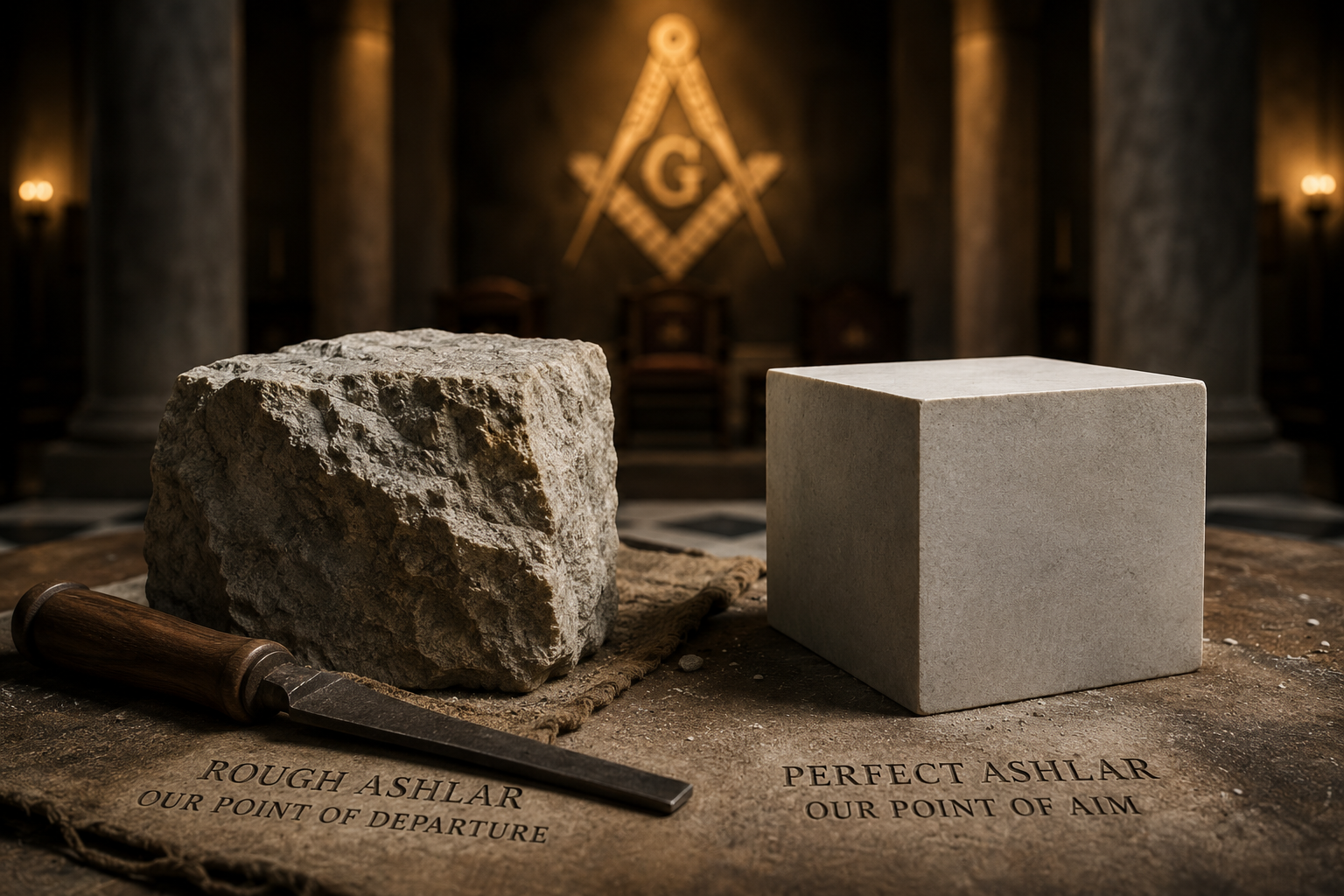
The Rough Ashlar reminds us of man in his rude and natural state, imperfect and unprepared for the spiritual and moral building before him. Beside it rests the Perfect Ashlar, representing that state of perfection we hope to attain through a virtuous education, our own endeavors, and the blessing of God. I’ve always found those words particularly meaningful because they never suggest that transformation simply happens. The lecture points us toward three essential ingredients. We are taught. We are expected to labor. We are reminded that God’s blessing must accompany our efforts.
I don’t believe the Perfect Ashlar sits in every Lodge because any of us will ever fully become it in this life. Rather, I believe it serves as a constant reminder that no matter how much progress we’ve made, there is always another rough edge to smooth, another lesson to learn, and another opportunity to improve. It keeps our eyes fixed on the direction we should be traveling, even if we know the journey itself will last a lifetime.
There is something wonderfully honest about that lesson.
The Rough Ashlar is never criticized for being rough. It is simply acknowledged for what it is. Neither is the Perfect Ashlar presented as something we have already become. It stands before us as an ideal, a reminder of what we should continually strive toward throughout our lives. I have come to believe that every Mason, regardless of how many years he has spent in the fraternity, lives somewhere between those two stones.
Over the years, serving as Secretary has allowed me a front row seat to watch hundreds of men begin their Masonic journey. One of the unexpected blessings of serving in that capacity is that you often have the privilege of watching a Brother’s story unfold over many years. You remember when his petition was first read, you watch him progress through the degrees, and, if he stays engaged, you see him grow into an officer, a mentor, or simply a dependable Brother whom everyone comes to trust. I’ve also watched men quietly disappear after receiving their degrees, while others remained members without ever fully embracing the experience. They all began with the same opportunities. They heard the same ritual, received the same instruction, and were welcomed by Brothers who sincerely wanted to see them succeed. Yet, after enough time had passed, their journeys often looked remarkably different.
For years I found myself wondering what accounted for that difference.
Eventually, I came to believe the answer was surprisingly simple. Freemasonry had fulfilled its promise to every one of those men. It had provided instruction, fellowship, encouragement, and working tools. What differed was not what the fraternity offered, but what each man chose to do with what he had been given. Some men picked up the tools and went to work. Others admired them without ever putting them to use.
That realization changed the way I understood one of Freemasonry’s most familiar phrases.
People often say that Freemasonry makes good men better. I understand exactly what they mean, and I appreciate the sentiment behind it. At the same time, I’ve come to believe there is a more complete way of understanding those words. Freemasonry doesn’t make good men better. Rather, it teaches good men how to become better by giving them the principles, the tools, and the opportunities to do the work themselves.
Years ago, long before I became a lecturer, or even a Mason for that matter, I spent a great deal of time powerlifting. One lesson my coach repeated so often that I can still hear his voice was that you don’t build muscle in the gym. The gym breaks the muscle down. It exposes weaknesses, tests your limits, and begins the process. The actual growth happens afterward through proper rest, nutrition, recovery, and the discipline to continue making good decisions long after you’ve left the weight room.
I’ve realized that the Lodge serves much the same purpose.
The Lodge teaches us. It challenges us. It exposes the rough edges of our character that still need attention. It places timeless principles before us and invites us to measure ourselves against them. Yet we don’t become better men while sitting inside the Lodge any more than we become stronger while standing beneath a barbell. The real work begins after the meeting has ended. It happens when we’re home with our families, when we’re dealing with difficult people at work, when we’re tempted to compromise our integrity, or when life presents us with opportunities to practice patience, humility, forgiveness, and compassion. Those quiet moments, far removed from the Lodge room, are where character is truly formed.
There is another part of Freemasonry that I believe deserves far more attention than it often receives.
Human beings naturally become like the people with whom they spend the greatest amount of time. Whether we realize it or not, our attitudes, expectations, habits, and even our character are influenced by the company we keep. Parents understand this when they worry about their children’s friends. Business leaders understand it when they surround themselves with talented people. Athletes understand it when they train alongside those who push them to improve. It is simply part of the human condition.
I believe this is one of the quiet strengths of Freemasonry.
When a man becomes active in his Lodge, he does far more than attend meetings or memorize ritual. He begins surrounding himself with men who are intentionally striving to become better husbands, fathers, sons, neighbors, leaders, and friends. They are not perfect men, nor would any of them claim to be. They are simply men who have acknowledged that there is still work to do and who have committed themselves to that work together.
That kind of environment changes people in ways that are often difficult to recognize from one meeting to the next. Over time, however, those small influences begin to accumulate. You begin thinking differently. You become more accountable. You develop a greater appreciation for service, integrity, and responsibility because those qualities are no longer ideas discussed during a lecture. They become qualities you begin noticing in the men sitting beside you, and eventually, qualities you hope others begin noticing in you.
I’ve watched Brothers stand beside one another through the loss of a spouse, encourage each other during serious illness, quietly provide financial help without seeking recognition, and celebrate another Brother’s accomplishments with genuine happiness rather than envy. I’ve watched experienced Masons invest countless hours mentoring younger officers simply because someone once did the same for them. I’ve seen friendships develop between men whose paths never would have crossed had they not knocked on the door of the same Lodge.
Those moments rarely receive recognition, yet they may represent the greatest work our fraternity accomplishes.
Perhaps that is one of Freemasonry’s greatest gifts. It does not simply place moral principles before us. It surrounds us with men who are sincerely trying to live those principles every day. While each of us remains responsible for shaping our own character, the journey becomes immeasurably richer when we walk beside Brothers who genuinely want to see us succeed. It becomes remarkably difficult to spend years around men of integrity without finding yourself challenged to become a man of greater integrity yourself.
As I’ve reflected on all of this through the years, I’ve come to appreciate the lesson of the Ashlars more than ever before. They remind me that every Mason begins as a Rough Ashlar, that every Mason should keep his eyes fixed upon the Perfect Ashlar, and that the distance between them is crossed only through a virtuous education, our own endeavors, and the blessing of God. There are no shortcuts. There is no substitute for the work itself. The fraternity can point us toward the destination, but it cannot walk the path for us.
Every time I have the privilege of delivering the Entered Apprentice Lecture, I find myself reflecting on those two stones a little differently than I did before. When I was a younger Mason, they reminded me where I was and where I hoped to be. Today, they remind me that the journey itself is the lesson. No matter how many years I’ve spent in the fraternity, how many offices I’ve held, or how many lectures I’ve delivered, I still wake up every morning somewhere between them.
Perhaps that’s exactly where every Mason is meant to spend his life. We are never asked to become perfect overnight, nor are we expected to arrive at the destination by our own strength alone. We are simply called to continue the work, one careful strike at a time, never losing sight of the example set before us by the Perfect Ashlar. If each day finds us a little more patient, a little more humble, a little more compassionate, and a little more faithful than the day before, then perhaps we are exactly where we are supposed to be. I have come to believe that every Mason, regardless of how many years he has spent in the fraternity, lives somewhere between those two stones, still shaping the man he was always meant to become.
Humbly and fraternally yours,
W. John Barling